15 August 2021
In the 75 years of her existence as a modern Western Democracy, India has done creditably for herself, as a force for stability not just within, but without. One cannot imagine the outcome in East Pakistan, in Sri Lanka, Nepal or Maldives in any manner different than how it panned out after Indian interventions, where the employment of military and trade & transit, was used to obtain the correct conditions which would benefit not just India, but more importantly the local polity foremost. In a sense, while adhering to notions of Western Democratic Project, India using Nehruvian statecraft and understanding of her own past, crafted doctrines like Non Alignment, Panchsheel and managed to effect desired conditions in her immediate neighbourhood when the situation so warranted. One Pakistani theory that if Mrs Gandhi was in power, Mr Bhutto would not have been ‘hung’ stands out for how, even as inimical as she sought to be, the fates of Pakistan, it seemed were intertwined with that of India. Truly the mantle of being the successor state to the previous Colonial India and actually in a more accurate way, to the ways of a subcontinental polity of commons that India was from times immemorial, fell with natural ease to India that is politically and geographically a truncated or moth eaten one, left by the British at Partition.
While India spent considerable energies assimilating her various tribal, cultural, religious and regional identities, she has sought to bring these about, using a bureaucratic and Western construct where the State was the unifier, the spinal spindles and sinews of this edifice. Whether it was the Chinese aggression in 62, or the Pakistani one in 65, provinces that were apparently rife with disaffection and insurgency, actually rallied to assist the Union and India’s Finest, her military, to address the contingencies that beset her. Later a rare political opportunity presented itself, when with a slew of accords, much of the restive insurgencies that claimed a stake in India, gave up arms and returned to political discourse. One cannot think of any post colonial where a dacoit gave up arms in response to a moral call by a political leader, nor can one think of another, apart from Good Friday Agreement, which involved multiple international parleys to bring about, where Assam, Mizo and Punjab Accords were to bring about eventually a political solution to aspirations. It was uniquely Indian, where the Western approach was trumped by Eastern civilisational genius, where the statecraft was informed by the concept of ‘Raj Dharma’. If today India’s secessionist tendencies have been laid to rest successfully, we must owe a debt to the visionary leaders from the ground up and those from Delhi, who eked out a process principle that remained clearly outside the realm of Western doctrine. It was to be based on a grey understanding of Indian Identity, even greyer understanding of Indian sentiments, Indian cultural and ethnic diversity, and an acceptance of dilution as a determinant in democratic expression. So if Tamil Nadu was agitated over Hindi imposition, English continued to be a second official language, a move that would help when the global markets commanded premium for English speaking white collar jobs. Indirectly it seems, India’s Vidhata was reminding her, that even her toughest choices offered intangible benefits, if only she kept faith in herself. The brutal assassination of Rajiv Gandhi, much loved in peninsular India as a progressive and visionary, put paid to dreams of a larger Eelam and to Tamil secessionist movements in Sri Lanka as well as India. By then, even the most agnostic of Sanskrit ( there is a very popular movement in Tamil Nadu that uses language to show case how distinct the Tamils are from every one else, by terming Sanskrit as ‘Vadamozhi’ ( Northern Tongue) and picking out Tamil classical words to replace Sanskrit words that had crept into lingua) the die hard Tamil, embraced wholeheartedly the larger Indian identity. In my view, this was the salute of descendants of an ancient people to the modern vision of Nehru-Netaji-Rajaji-Patel, in that order, who shaped the destiny of peninsular India, through their leadership.
A concessionaire approach had mellowed fissiparous tendencies, promoted a centrifugal force that promoted culturally a version of modern India that could become diminished in her strength in terms of pluralism, simply by loss of patronage, is vividly recorded by linguists and social anthropologists, in the context of simply the loss of various dialects of ‘Hindustani’ that were once widely used across the Great Indian Plains. It was once said proudly that “every 5 kos offered a distinct lingua and distinct variety of rice”, the kos being roughly 4 km, so every 20 sq km patch of India’s Gangetic plains was so rich in its diversity of agriculture and culture! Yet, not just dialects, but rice varieties too died out falling prey to a new vision of ‘official India’, where efficiency and yield was more important than redundancy and sustainability. Over the years, an aspirational and somewhat impatient bureaucracy increasingly has veered toward a more Western system, deracinated it would appear, from the complexities that is the Indian subcontinent. The urge to make a one size fits all, has accelerated development in some measurable statistics no doubt, yet, the effect of derailing the larger Indian compact and culture that such a view and policy has had, is also now clearly visible on the horizon over what I call the ‘immeasurables’.
Where the EU is showing a new approach toward multi cultural and multi ethnic regional management as a polity, India’s invested bureaucracy is still adherent to Bretton Woods and TransAtlantic Western view that was prevalent at the close of the Second World War! Where a normal EU meeting uses plethora of linguist interpreters, opening up careers in translation, India’s hallowed Parliament has seen efforts to enforce a Sanskritised Hindi as an official lingua of discourse, and by extension, seeking to make India undertake a journey from ‘Union of States’ to a ‘Unitary State’. If Western Concept is undergoing transformation, led by non Anglican leadership of France and Germany, which uses science and linguistic plurality as its cornerstones, which accepts a statist view of secularism while offering religious liberties, Indian bureaucracy is stuck in the past version, almost like using an outdated Windows OS Windows NT 3.1, when rest of the Microsoft environment is using Windows 10 and awaiting the release of Windows 11!
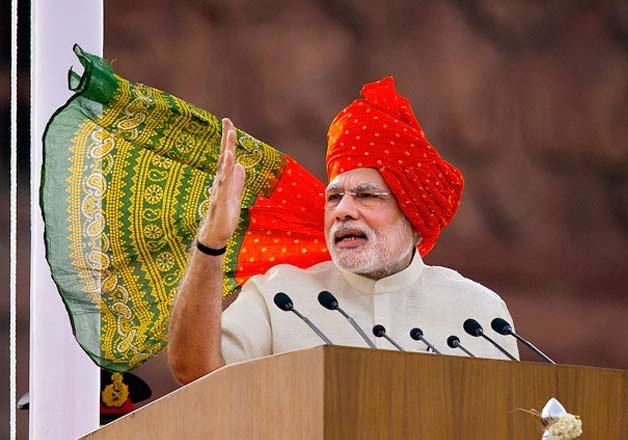
The need to revisit our recent mindset is as critical as the need to remember Partition, as PM Modi has passionately sought. Marking 14 August as Remembrance of the Holocaust that was Partition is crucial to revisiting that momentary madness that had possessed us, especially in the aftermath of 1971, and comparing the trajectories of India versus Pakistan. This sharply resonates today with the Taliban running over capitals and provinces and closing in on Kabul, again putting paid to a dream of a plural, gender positive and secular polity through religious fundamentalism and doctrinaire politics that is rooted in medieval mindsets!
We can invoke National Poet Subramanya Bharati who placed 100 years ago for us a template of nationhood that was both ancient and modern, for it was truly timeless. Bharati wanted 30 crore Indian faces ( that was the entire population of British India back then, including Ceylon, Burma and Aden) who spoke in their own individual tongues to remind themselves that their ‘dreams’ were one. Dreams anchored in universal values that echo across our civilisations and cultures, dreams that offer fraternity, equality, liberty, justice and freedoms for each one of us! Further Bharati wrote “Of this earth, may India be an example, a ‘good country’” using the Tamil root ‘Paru’ ( Sanskritised as Parth/Prithvi), where he sang of Goodness of a Commons for Good of the Commons! Even beyond the National Anthem composed by Gurudev, which evokes an India of regions, subject to a ‘Bhagya Vidhata’, Bharati’s poetic imagery is timeless and can encapsulate the very ancient Indic arc written in Puranic lore as well as Sangam Classics, mentioned authoritatively by Greek and Roman historians and recorded by Chinese Buddhist travellers!
Standing on the anvil of a new era, a post Pandemic World where many of the nostrums of Western Capitalism have fallen by the wayside, where a climate challenge will force governments to reimagine the role of ‘Debt’ and ‘Infinity Borrowing’, where China offers a totalitarian regime that purportedly offers incentives for ‘model citizens’, a new template from a timeless civilisational India, as a ‘Good Country’ as a Commons of the World, can offer a clear alternative that is sustainable and capable of empowering the weakest person amidst us as dreamt by Mahatma Gandhi!
In such a sweep of our antecedents, it is easy to gush with enthusiasm and rush forth to claim a path, that once was ours as globally and as heritage. Is #NewIndia up to such an arduous task?
 indiarubberman.com