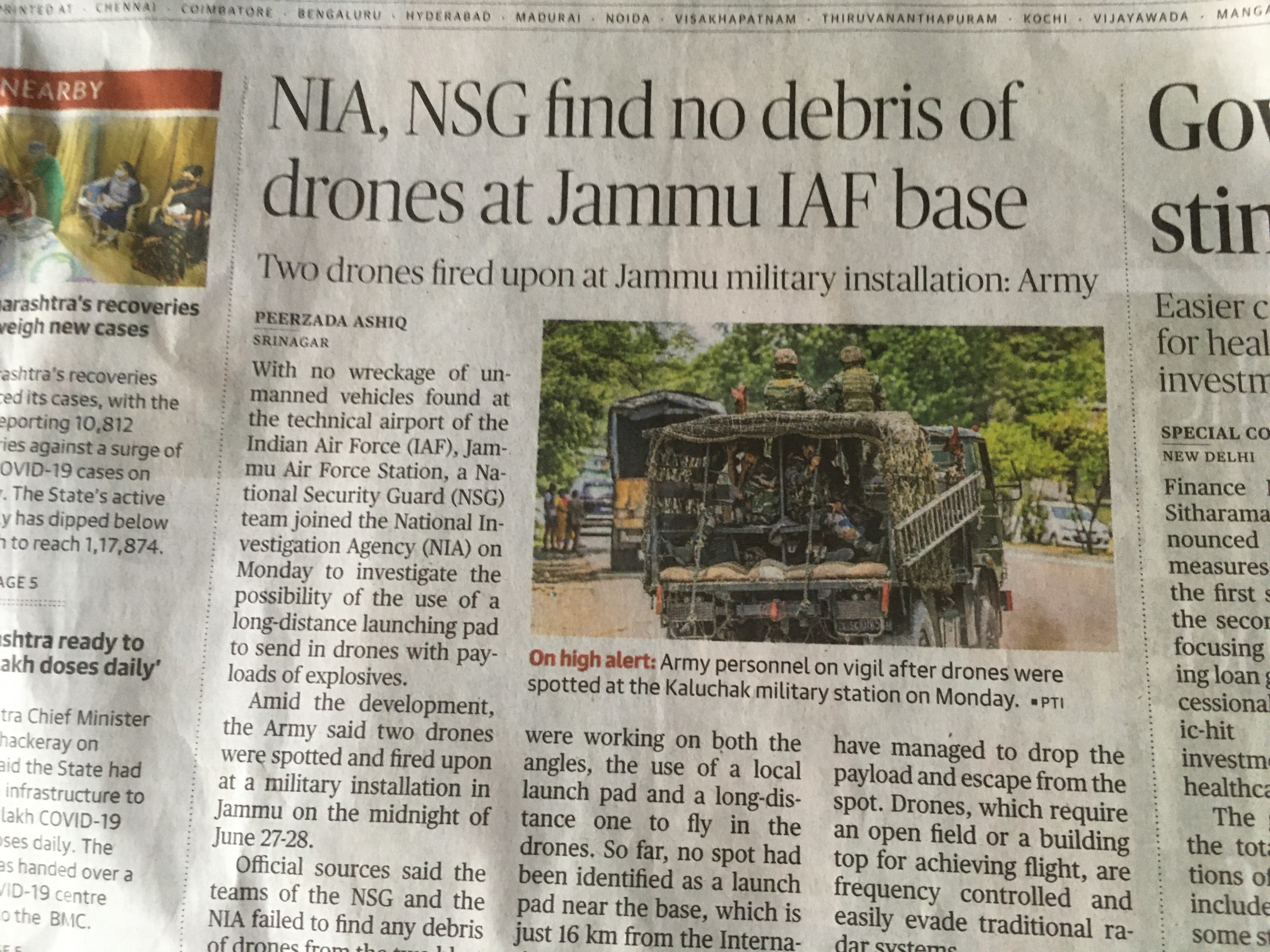
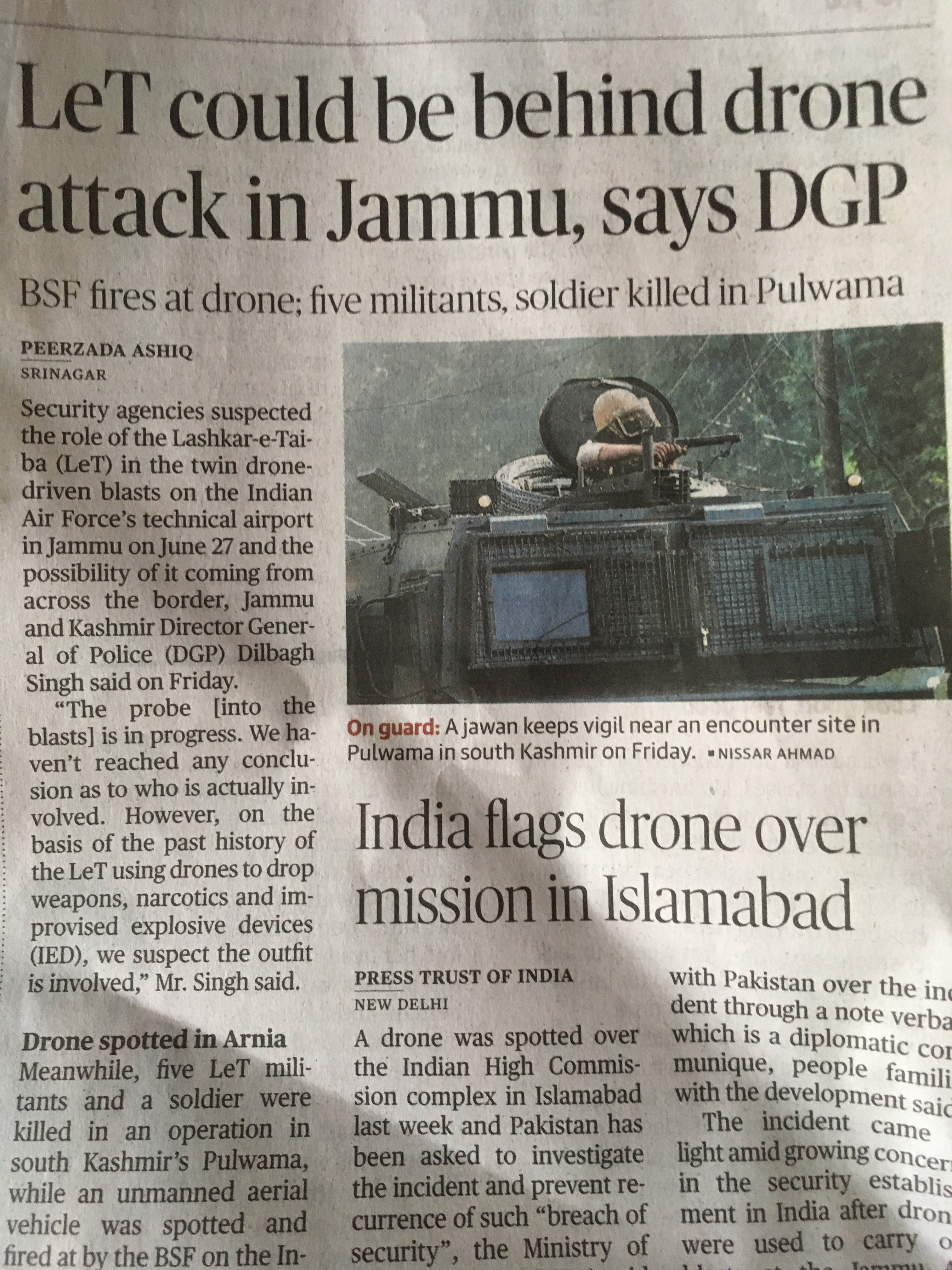
HEADLINES From The Hindu on 29 June and 3 July 2021 say it all!
03 July 2021
We have had much of back and forth on the Jammu Air Force Base as well as some Army border posts, claiming the passes made by drones allegedly tossing some explosives that would have damaged the sensitive security related areas of India’s First Line of Defence. Even as now NIA is likely to investigate, after first denying the presence of drones, we are likely to see more claims of such drone sightings, like the one made by Islamabad Indian Diplomatic Mission as well. Questions that drone presence bring are many, but the tactical ones need address first.
Does India actively update a list of no fly zones for drones?
Under UAS Rules 2021 issued in March this year, the government offers a seemingly exhaustive list of areas demarcated where drones that are registered under the DGCA manual are not to fly over, attracting penal provisions with fines ranging from the thousands to several lakhs if the offence is merely of flying over and not associated with arms or munitions. It does cover both the border areas (25 km) and Air Force Stations, (3 km) and for those who are more interested the gazette is linked here.
However enthusiasts in the field and analysts will offer reasons why such exhaustively written rules thwart not just development of drone technologies and drone activities in India but also end up damaging our ability to offer effective security solutions against drones using smart fences, scanners and identifying them early enough, that installations that need protection from drone flyover, loitering and offensive action, can deploy counter drone aerial and ground based measures, escalating the presence of drones to hostile action.
Does India have any capability for addressing drone hostile actions?
While experimentally right now the USA itself is just getting it’s THOR which is Raytheon produced microwave on mount to fry drones from the air, as well as deploying the X MADIS from Ascent Vision, Indian Defence Research must be with some capability for at least what New Delhi would consider as vital such as Vijay Chowk in the heart of Lutyens Delhi, now at the centre of the Central Vista development.
However the way, this current issue of unwelcome drone presence over sensitive areas has played out so far, this much is clear that neither the air force deployed at Jammu nor the Army near the border in that region have any wherewithal to counter their presence. While a drone flying over is one level, dropping munitions over a target area is at another level of this drone based escalatory cycle. The Jammu air base episode is clearly a more worrying development than that reported by the army or the embassy staff in Pakistan. So how does India propose to counter this? Do India have any drawing plans? Any doctrine for Drone-attacks like one it has for Cyberattacks?
After the campaign by Azerbaijan over Armenians in Nagorno Karabakh last year, Indian military observers and analysts have been talking of how the drone weaponisation would be the next level threat in India’s counter insurgency as well as hot war scenarios. So whether Indian military commanders debated this aspect is not a question, whether the powers that be acted on inputs and offered viable strategies and operational options to the military is an open question.
What does the drone incidents imply to Security Calculus?
India has the most vulnerable soft state image, one that last seven years of ‘muscular diplomacy’ or strident nationalism under Mr Modi’s leadership has been quite unable to shake. This despite the publicly shared and celebrated Uri Surgical Strike and the Balakot Air Strike. If agencies have zoned in on cross border operatives for the present round of drone episodes, what is going to be her military response? Unlike Pathankot Air Base or even the Uri Army camp, where conventional means of using cross border teams of motivated armed persons to carry out raids was the issue, drones are too cheap in terms of human and economic costs for Pakistan or China to toy about. China being a world leader in drone development, including in drone swarms development, and now all weather friend and ally of Pakistan, the threat from drones to Indian security framework is far too clear and emergent to be reactive. What we need is a series of howlers, folk who can run their imagination wild and come up with scenarios where Pakistan or China can use drones to inflict costs on India and lower our morale and military preparedness. For example to repeat a Pulwama now in a drone enabled scenario would be far less strenuous or require far less planning and motivation than actually ramming a C4 laden car in a suicide attack.
Can we imagine a scenario where an event is taking place in a stadium, and drones appear within vicinity, with a ransom call placed to an authority- pay up or else! How will India treat this scenario? Will it be equal to a ‘hijack’ situation? Will there be a national level authority who will ascertain credibility of the threat, authorise counter measures or negotiate with the miscreants? In a relatable blog I have explored the spectrum of hybrid war with AI capabilities for which a chosen platform readily available to users is drones. And I am sanguine that India’s Deep State has already ‘war gamed’ this to the fullest extent of current and anticipated capabilities and planned counter measures to these.
However, the public postures and responses in the wake of the current episodes reveal an uncoordinated approach by authorities, including police authorities. Just as Air Accidents are not investigated by local police, authorities invested with Central Government Strategic Security Mandate need to make clear that UAS incidents and accidents cannot be in the domain of local law enforcement. Firstly these are outside domain expertise of local thana, but more importantly it would need a dedicated branch within even an agency like NIA co-opting experts from IAF, DGCA and Aviation Industry, as either ‘loaned assets’ or integrated from a pool of veterans with expertise in these fields. I would find deputation a better suite option, since it could rely on updated professional knowledge from such class of experts, whose quality would be more reliable compared with veterans.
What the incidents have shown is no matter who is the PM or which party is in power, security issues that plague India are ‘secular’ and their response needs coherent and holistic approach.India could do away with adhocism and embrace a systems approach for emerging hybrid security challenges to her security framework. Post Kargil the High Powered Committee made several recommendations including on intelligence. Now with the changed geopolitical scenario, India is on an enlarged intelligence sharing list with US and her allies, under the Five Eyes Alliance. Hopefully, India will focus on hybridisation and asymmetrical warfare as a whole and not resort to more junky options like creating a Drone WarFare Command.
One can call the Jammu drone episodes as ‘curtain raiser’ to the next level of hybrid security challenges, if such a curtain raiser was ever required in the first place. However India being India, she responds better when a crisis and its fullest extent stares her down her face!
 indiarubberman.com