10 June 2021
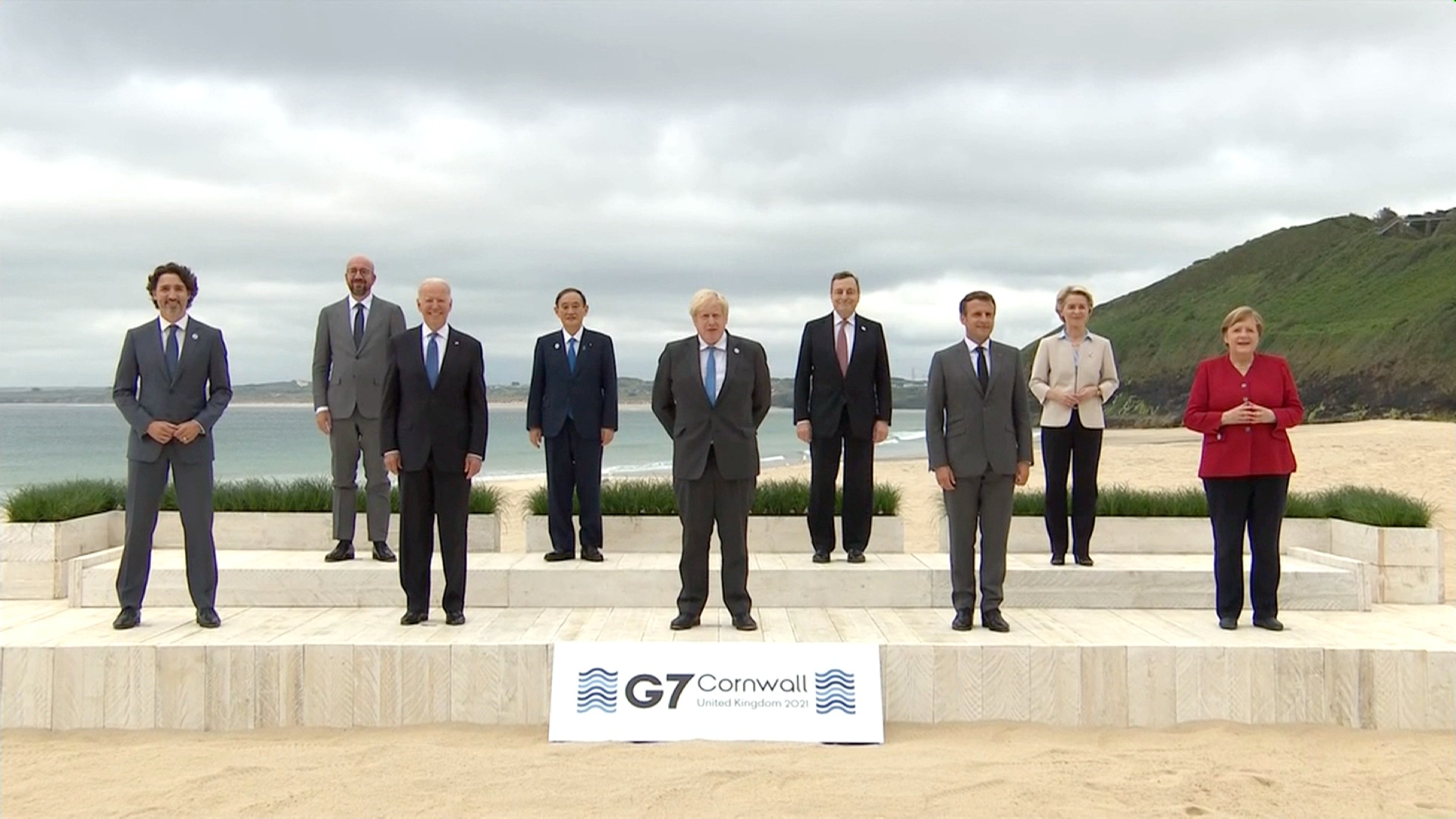
In what can be called great tidings, the major nations that make up G7 other than USA reported a much needed return of confidence in their polity toward the Biden Administration, upwards of 70% as per PEW which is dramatic considering the pitifully low confidence American allies had expressed under Trump Administration. Remember America’s current contestant number 1 CCP China has faced a sinking confidence from global polity in the last one year that has forced the Supreme Leader President Xi to shift gears, ordering his Diplomatic Corps to foster a ‘loveable image’ of the Main Land amongst peoples! So these polls do count for something.
That said, the G7 has already made certain key signals that indicate that sentiment alone is not driving this revival of public confidence reposed under Biden’s leadership. We have an ambitious 1 billion doses plan for 100 countries across the world in terms of Covid 19 vaccinations, which includes a 500 million doses order for Pfizer BioNTech from the USA itself. It is in addition to US led efforts currently underway, primarily to make for the shortfall India has generated by failing to adhere to the COVAX requirements for Oxford-AstraZeneca shots, whose creators were honoured in the Queen’s Birthday Lists this year. Covishield as it is locally known in India, is made by Serum Institute and has become the mainstay of India’s own vaccination efforts, after the alternative Bharat Biotech struggles to deliver doses of its killed vaccine Covaxin and has been unable so far to meet standard regulatory compliance by releasing its Phase III clinical trials data as well as its full efficacy data so far. As India seeks to reenter the economic spheres, after being in lockdown for much of last year, she is now confronted with just one Covishield that has international recognition, a shot which she has successfully administered to her government officialdom and the Armed Forces, as well as essential workers so far. Her programme for vaccinating three categories of age groups appears to get back on track after PM Modi announced that the Centre would resume all of the procurement, in compliance with the Supreme Court’s express orders on the subject. Why vaccination issues are a subject in a pandemic era, is obvious. Why India’s dilemmas and delicately poised struggles to normalcy in the face of a crushing second wave are so important is because the global decoupling efforts were till now focused on India being the alternative to China in terms of availability of both market and labour. Early speculation about India’s chances now seem mired in greater doubt after the second wave devastated the local economy and pushed millions more into poverty, which now has make it clear that without vaccination, there is no ‘return to normal’ for India. South Asia watchers are keenly awaiting the outcomes of India’s talks with USA, G7 and Quad to see if the vaccine availability would get addressed by global support. In G7 President Macron made a passionate case for supporting India attaining self sufficiency in vaccine production for Covid19, asking members to loosen export controls and purse strings to support this effort.
However, India’s neighbourhood is showing a picture that is a new South-South moment with Bhutan, Bangladesh and Sri Lanka accepting the reality that India is itself in a tough situation and unlikely to help further. So not just Russia, Japan too has entered the fray, offering Astra Zeneca jabs to Bhutan, Bangladesh and Sri Lanka by August so that these countries can resume their interrupted vaccination drive. Nepal is likely to benefit directly from USAID because the situation there is far too immediate to await an effort of calibrated response. In fact, if one can look at how G7 is operating, it goes without saying that right now China’s immediate neighbourhood is at the centre of its focus, for military and civilian aid. This places Taiwan in a much more comfortable situation than it did under the Trump Administration. It also emboldens Philippines to actually stand up to China in the high seas as well.
G7 is planning to approve a 15 % alternative taxation for incomes of all Big Tech companies from Apple to Google, companies that are primarily on line as service providers or content hosts. Internet of Things has created this new seamless market, which is blurring national boundaries not just for logistics chains, but the work flow itself! So the formula of offering percentage of revenue generated as local versus global of this 15% across all nations is one clear way for G7 to target Tax Havens, even though some like Virgin Islands are technically UK territory. It also remains to be seen how G7 will view a decision like that of El Salvador to accept Bitcoin as a tender in that country, and whether Central Bankers of these global economic giants, will enter cryptocurrency markets themselves in the near future.
If the US decision to revisit the origins of SARS CoV2 are signalling, then it is already a success, what with a top Chinese diplomat from the inner circle of President Xi, Director Yang Jiechi, directly reaching out to Secretary Blinken recently, seeking assurances in the context of Wuhan Lab leak theory. Especially since, Guandong which is China’s export hub, is right now in the grip of a new wave of Covid19 perhaps spurred by the new VoCs which have halted production and shipping there. There are global concerns with supply of smart chips, (Semiconductor silicon chips that are at the heart of nearly every device now used by humans, of which the bulk requirements of lower order chips are manufactured in China.) where on the one hand US automakers and appliance makers need chips from Chinese manufacturers, even as US Government has blanked out China from high end chips and technology primarily to derail Huawei’s 5G launch and also to deny China a cutting edge technology where US leads the design field and Taiwan are the sole manufacturing foundry! TSMC is so exclusive that an entire arena of sub 10 nanometer chips are simply its monopoly. If you thought that Intel was there, you will find Intel struggling to enter the field where TSMC has blazed its trail with mass production of 5nm chips this year and likely to soon come to 1nm. These chips are the heart of the neural network that is now AI plus ML stuff that devices are depended upon, from autonomous cars to smart phones, to execute. Apple’s fabled M1 is the first chip in the Cupertino company that are designed and now manufactured not by Intel but by TSMC only! So if Americans have now indicated that they will be able to counter an invasion from the mainland and defend Taiwan, one key detail is Hsinchu Science Park, where TSMC is headquartered, which is key to the US military NextGen war fighting capability, whose F35s are bearing smart chips from this company! In what could be a tectonic shift, one expects at some point, South Korea, Japan and Taiwan to exchange military notes and forge a joint military strategy nudged by the Pentagon, over coming their Second World War antipathies and trust issues therefrom.
So G7 recognised three critical aspects in its understanding of what it needs to invest in to maintain status quo:
- Technological Edge in Critical Areas is an absolute must, hence China will see barriers in technological access from Germany, Taiwan, France, UK and with the changed government in Israel, hopefully from Tel Aviv too!
- Vaccination efforts globally since the ‘delta’ strain has proven that our vaccination efforts as a shield against being overwhelmed by the pandemic is itself a tenuous one. So now beyond underwriting cheques, the G7 will be hands on, to ensure global vaccination of significant populations by 2022.
- Monetary Inequality is sought to be addressed by offering symbolic and where possible substantial relief to citizens vis-à-vis corporates and the movement to make free market economy more human is part of what G7 now considers as a fundamental flaw in democracies- extreme income disparity. So we can expect more than token socialist measures globally, even as the G7 tries to enforce global commitments on Carbon footprint reduction in the face of the clear Climate Challenge.
We can see how G7 has changed gears in dealing with Russian, Turkish and Chinese challenges, that last year appeared to come with so many riders and conditions that democracy sounded less appealing in face of the apparent triumph of absolutism. There is still an elephant in the room, India, where Democracy must win, where free markets must win, for India is too big by many yardsticks, especially in this pandemic era to be tucked into a corner. However, considering the road travelled from 1 January to 1 June, G7 has considerably evened the odds, offering democracy and free enterprise more than a fighting chance against totalitarianism every where!
 indiarubberman.com