25 February 2021
In what can be characterised as Great Power ploy, President Biden has chosen to moot an alliance of Democracies, simply as an ideological counter to CCP China which is a regime that can be loosely characterised as Non Democratic. What observers are unable to see, Fareed Zakaria included, is that Biden strategy is not a continuation of Trump moves, it is a larger more coherent response to halt American retreat from the Global Arena and signal a willingness to continue and dominate it, from Iran’s Nuclear question to North Korea’s problem regime, to China’s own global ambitions and the Climate Challenge.
In what can be called an interconnected web of issues, President Biden sees this global order issue as part of a larger national interest of the American Future, which includes not just strengthening American democracy, making American society more inclusive, but also by offering Green initiatives against the Climate Crises, by posturing as Democracy’s guardian, he is offering to the world abroad a cementing mixture of ideological glue and national interests, in his broad based efforts to contain China.
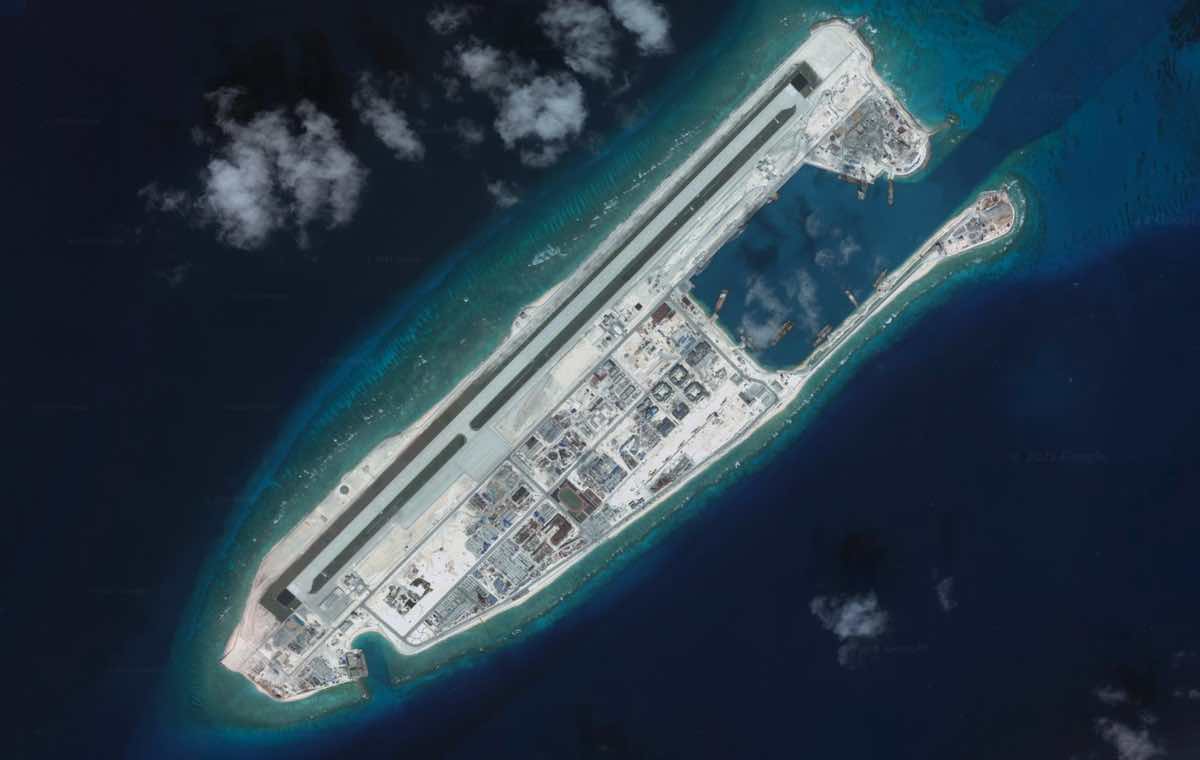
Sitting on possible 15 trillion barrels of Natural Gas and 33 billion barrels of oil so far in South China Sea, the next Persian Gulf as some call this area, is going to remain a contested bed of unequal rivalries, amongst the ASEAN neighbours and China, only as long as fossil fuels remain the energy staple of the global economy. So if at one time, shale was promoted by President Obama, Biden would see that as a stop gap, a necessary evil to wean the US finally from Persian Gulf oil sourcing, and now the Green New Deal push to go Zero Carbon by 2050, would imply that alternative energy sources would avoid an American tap from SCS! As the world’s largest consumer for quality fuels, and one of the top 3 for overall fossil fuel budgets, USA would have far reaching implications by its decision to withdraw from this sector entirely. The strategic thinking of the USA since Obama years has been to not posit a dependency of critical nature on any region or country, one that has been further cemented by the Pandemic disruption which brought much grief to US consumers and manufacturers, calling for a systematic decoupling from China. So what we are likely to see with Biden Administration is more coherent and less visible animosity toward China, one that will involve a clear and concrete response to the Chinese challenge!
That is why in the early review of matters global, it would have struck the Blinken led State Department to observe how US withdrawal from South Asia by President Trump left a vacuum, and how the recent events in Nepal and Myanmar offer USA a reentry of sorts. So the SC of Nepal restoring the Parliament would mean that PM KP Oli is likely to lose his mandate to rule Nepal after a No Confidence Vote in the reinstated Assembly. It was widely rumoured that CCP delegates and diplomats of China had desired this coup of sorts by PM Oli, so as to cement the concessions and diplomatic slant that were obtained for China by extracting favours from the Oli government. It included Nepal actually indulging in a cartographic dispute with India, its culturally and geographically not just historically allied neighbour south! This was a cementing move from China to portray a case where India is shown as having cartographic disputes with not just China, but also with her smaller neighbours. So will Secretary Blinken do some lifting here, intervening in Nepal after the vote?
The American State Department has never officially operated with this paradigm shift where her foreign policy is led by PacCom ( now rechristened INDOPACIFIC Command) and not CentCom. Pentagon under Gen Lloyd Austin a former CentCom commander, is uniquely placed to guide this tectonic shift from a Pakistan centric South Asian and Asian view, to an India centric Asian template, and just how the Biden Presidency is able to pull this off will determine how successful the US efforts to contain China would be. Keenly the State Department will watch how within hours of Chinese withdrawals from one sector in Ladakh, New Delhi permitted Chinese companies to invest in India, ensuring that China would remain the top trading and investing country in India for foreseeable future. If history is any teacher, without a Marshall Plan for Europe and Japan, without American trade and economic partnership with these two blocs, there would have been no basis for the post world wars ‘American Century’. So how soon will Americans think and craft a plan to wean India off from China, even though the priority right now would be to wean EU off Chinese investments and Russian Gas!
Unlike China, American soft power is still seen as a positive transformational force, not withstanding the toolkit controversy or the Riri Twitter storm in India. Indian NRIs remain largely vocal about their support for both American supremacy abroad and Modi momentum in India. We know that US administration now will have a number of Indians as its top officials even if Ms Tandon is facing confirmatory hearings trouble in the Senate over her social media history. The Democrats are overweight with American South Asians even before Kamala Harris was a political worthy in their politics. So the real game changer is likely to be this nuts and bolts alliance between the world’s oldest and largest democracies, USA and India. Naturally in isolation it would make China nervous, but as a global alliance of democracies, it would be less obvious.

That is where Myanmar is a test bed case. We see the MEA and the State Department indulging in back and forth, like team players. A level of synergy, which is being handled by professionals for a change, in South Block, New Delhi was cautiously optimistic that the coup was likely to meet with resistance in Myanmar and now can claim it was fairly unsurprised at the mammoth rallies https://in.news.yahoo.com/elephant-riders-join-myanmar-coup-103548758.html in protest against the military. It is also clear that the coup largely sought to reset the relationship with China which had soured under the Su Ki dominated NLD government. China had made huge investments in Rakhine province and also in port development and evinced keen interest in consolidating its investments in the Cocos islands in the Bay of Bengal. This was all wilting and five more years of a stronger Su Ki regime would have been too risky, which is why China stepped in, like how it did with Oli in Nepal. How much of the street protests in Myanmar is raw effort and not RAW effort? Did the Nepal SC order https://www.outlookindia.com/website/story/world-news-nepal-sc-reinstates-dissolved-parliament-annuls-decisions-by-incumbent-govt/375222 reinstating the dissolved parliament contain Indian judicial inspiration https://thewire.in/law/supreme-court-foreign-citations-study or nudge? Baburam Battarai a prominent Nepali leader definitely used a familiar Indian analogy “ Bhasmasur” where he compared the action of the Nepali Constitutional Bench led by CJ Cholendra Shumsher JBR to Lord Vishnu’s intervention causing the death of the demon Bhasmasur! The order is decisive, as it annuls all decisions of Nepali government from 20 December 2020, and restores the status quo ante with effect from then, including the House of Representatives of Nepal’s Parliament.While overtly these could be deemed coincidence, the retreating PLA Western Theatre Command and the mandarins of President Xi will be viewing these events, not as Chinese chequers gone awry, but evidence of deepening nexus between Delhi and Washington.As coups to coups, as upstaging as can be…a new Great Game is now Fair Game, all along this tectonic alignment of the Indian plate against the Asian plate, in which the presence of a French nuclear submarine in the waters off Vietnam is very much the calm eye of a gathering global storm!
 indiarubberman.com